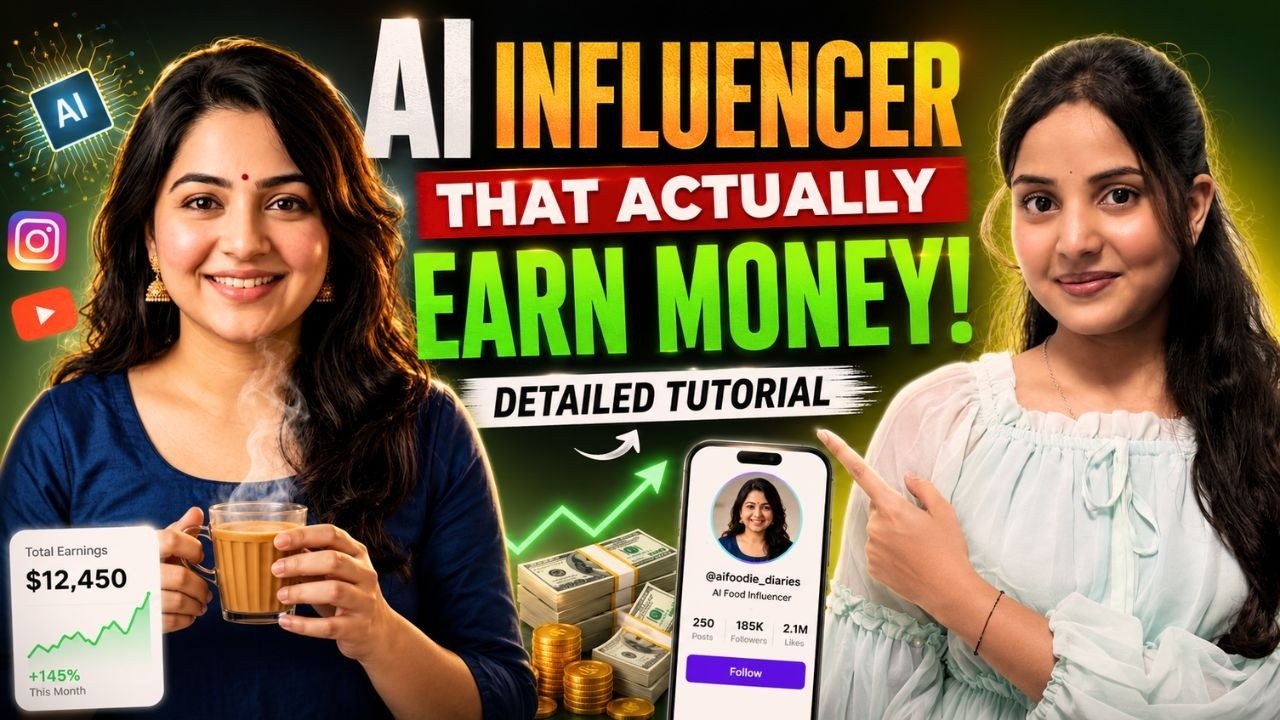
AI influencers are becoming increasingly popular across Instagram, YouTube, Facebook, and other social media platforms. But there is an important difference between simply creating an attractive AI character and building an AI influencer that people actually want to follow.
Generating random dancing videos or posting beautiful AI-generated portraits is unlikely to be enough. A successful virtual influencer needs an identity, niche, personality, story, recognizable face, consistent voice, and a clear content strategy.
The goal should not simply be to create an AI character. The goal should be to create a digital personality that audiences can recognize, remember, and eventually trust.
In this guide, we’ll go through the complete process of building an AI influencer from scratch.
1. Start With a Clear Niche
Before generating your influencer’s face, decide what the influencer is actually going to talk about.
This is one of the most important decisions in the entire process.
Possible niches include:
- Food and cooking
- Fashion
- Beauty and skincare
- Fitness
- Travel
- Technology
- Personal finance
- Lifestyle
- Education
- Entertainment
For this example, we’ll use an Indian food and cooking influencer.
Instead of keeping the niche extremely broad, it can be narrowed further to something such as North Indian home cooking.
This immediately gives the character a stronger identity and makes future content planning easier.
2. Decide Which Platforms You Want to Target
Next, determine where you want to build your audience.
You could focus on Instagram first, but you can also create content that works across multiple platforms such as Instagram, YouTube, Facebook, and TikTok.
A multi-platform strategy can be particularly useful because one piece of vertical content can often be adapted for several platforms.
However, your influencer’s identity should remain consistent everywhere.
The profile picture, name, personality, niche, visual appearance, and overall content direction should feel connected regardless of the platform.
3. Build a Complete AI Persona
This is where many AI influencer projects go wrong.
A consistent face alone does not create a personality.
Before generating hundreds of images, define exactly who your character is.
Determine details such as:
Name: What is the influencer called?
Age range: Is the character a young creator, mature expert, or something else?
Personality: Energetic, funny, sophisticated, calm, educational, trendy, traditional?
Niche: What specific subject does the character specialize in?
Backstory: Why does this person create this type of content?
Audience: Who should connect with this influencer?
Content style: Tutorials, entertainment, storytelling, reviews, tips, recipes, etc.
For example, an Indian cooking influencer could be a young and energetic creator sharing quick North Indian home-cooking recipes inspired by family traditions.
That is already much stronger than simply saying:
“Create a beautiful Indian female AI influencer.”
The character now has a reason to exist.
4. Make the Personality Match the Niche
Your character’s personality should naturally fit the content.
A young cooking creator targeting Gen Z audiences might be energetic, conversational, modern, and slightly playful.
Another cooking influencer focusing on traditional recipes could have a warmer, calmer, family-oriented personality.
Neither approach is necessarily better.
What matters is consistency.
Your character’s appearance, clothing, language, environment, expressions, and content should all support the same identity.
5. Generate the Reference Face
Once the persona has been finalized, you can begin designing the influencer.
Create a detailed image-generation prompt describing the character you want.
You can use an AI assistant to develop and refine this prompt before using it inside your preferred image-generation platform.
The first image is extremely important because it can eventually become the master reference image for the influencer.
Don’t immediately accept the first result.
Ask yourself:
Does this character match the niche?
Does the character match the intended age?
Does the personality come through visually?
Would this person look believable as a creator in this category?
If the answer is no, refine your prompt and generate again.
6. Create a Reference Face Set
After finding the perfect character, don’t stop with one image.
Generate the same character from multiple angles, outfits, expressions, environments, and camera distances.
For example, you could create approximately 15 reference shots including:
- Front-facing portrait
- Left profile
- Right profile
- Medium shot
- Close-up
- Smiling expression
- Neutral expression
- Indoor environment
- Outdoor environment
- Different hairstyles
- Different outfits
- Cooking environment
- Lifestyle portrait
- Talking-head composition
- Full or three-quarter body shot
The objective isn’t to make all 15 images identical.
The clothes, environment, hairstyle, pose, and camera angle can change.
What needs to remain recognizable is the character’s identity.
A good reference set makes it significantly easier to maintain facial consistency when producing future content.
7. Turn the Character Into a Reusable AI Character
Once your reference images are ready, save the influencer as a reusable character inside your chosen generation workflow when that functionality is available.
For example, the workflow demonstrated in the source uses Google Flow to save the generated influencer as a character that can then be referenced when creating new scenes.
This is much more efficient than redesigning the influencer every time you create a new post.
Your future workflow becomes:
Character → Scene → Dialogue → Video
rather than:
Create an entirely new person → Generate image → Try to match previous face → Fix inconsistencies → Create video.
8. Voice Consistency Is Just as Important as Face Consistency
Imagine following an influencer whose face remains identical but whose voice completely changes in every video.
It would immediately feel artificial.
That’s why your AI influencer needs both:
Visual consistency + Voice consistency
The speaking style matters too.
Decide whether the character speaks quickly or slowly, uses Hindi, English or Hinglish, sounds energetic or calm, and communicates casually or professionally.
The goal is to make viewers recognize the influencer even before they consciously think about it.
9. Create Talking-Head Videos
Now you can start transforming the character into actual video content.
Instead of prompting only for appearance, describe the complete scene.
Include information about:
- Character
- Environment
- Camera framing
- Character action
- Facial expressions
- Hand movements
- Dialogue
- Voice style
- Lighting
- Background activity
For example, a cooking influencer could stand inside a realistic home kitchen and explain a quick cooking mistake while naturally gesturing toward the ingredients.
Short clips are particularly useful because they give you greater control over the final video.
If one part of a generated clip is excellent but the ending contains an unwanted repeated sentence or awkward movement, keep the good section and remove the unnecessary part.
10. Build Longer Videos From Multiple Short Clips
You don’t necessarily need to generate a complete 30-second video in one attempt.
Instead, break the content into smaller scenes.
For example:
Clip 1: Hook and introduction
Clip 2: Explain the problem
Clip 3: Demonstrate the solution
Clip 4: Final tip or conclusion
If each clip is around eight seconds long, four clips can create approximately 32 seconds of content.
The individual clips can then be combined into one complete short-form video.
The source demonstrates this approach by generating multiple eight-second segments and combining them into a longer cooking video.
This method can also make it easier to control expressions, dialogue, camera composition, and pacing.
11. Create an Optimized Social Media Profile
Once your influencer and first few videos are ready, build the actual social media profile.
Your profile should immediately answer three questions:
Who is this person?
What content do they create?
Why should someone follow them?
Start with a simple, memorable username related to the character and niche.
Then optimize the display name with relevant niche keywords.
For example:
Zara | North Indian Home Cooking
This immediately communicates both the character identity and content category.
Your bio should also be specific.
Avoid filling it entirely with generic phrases that don’t explain what followers will receive.
Instead, communicate your content promise.
For example:
Quick North Indian recipes 🌶️
Simple home cooking without the drama
New recipes every week 🍛
The original workflow similarly recommends connecting the username, display name, and bio directly to the influencer’s North Indian cooking identity.
12. Use a Recognizable Profile Picture
Choose one of your strongest reference images as the profile picture.
Ideally, it should have:
- A clearly visible face
- Clean background
- Good lighting
- Strong facial identity
- Minimal distractions
Remember that profile pictures appear very small on mobile devices.
The character’s face therefore needs to remain recognizable even as a small circular thumbnail.
13. Consistency Is More Important Than Early Views
Your first few posts may receive very few views.
That’s normal for a new page.
Don’t completely change your strategy after three or four videos simply because they didn’t perform well.
Instead, continue improving.
Experiment with better hooks, stronger storytelling, trending formats, improved visuals, different posting times, and more engaging topics.
But keep the core niche consistent.
If you created a North Indian cooking influencer, suddenly turning the same account into a fashion, gaming, motivation, and travel page will weaken the identity you’ve been trying to establish.
The source places particular emphasis on maintaining the selected niche while continually improving the content itself.
14. Find the Best Posting Time
Don’t blindly assume that one universal “best time to post” works for every account.
Experiment with different posting times and observe when your audience is most active.
Once you identify a pattern, build consistency around it.
For example, if you promise followers:
“New recipe every Friday at 4 PM”
then try to publish every Friday around that time.
Over time, your audience can begin expecting content from the character on a predictable schedule.
15. Don’t Chase Every Trend
Trends can help increase reach, but they should support your niche rather than replace it.
A cooking influencer can participate in:
- Trending recipe formats
- Viral ingredients
- Food challenges
- Trending editing styles
- Popular audio
- Seasonal recipes
But suddenly posting unrelated viral content simply because it is trending can confuse the audience.
Use trends as a content format, not as a replacement for your identity.
The Formula for a Successful AI Influencer
The complete strategy can be summarized as:
Clear Niche + Strong Persona + Backstory + Consistent Face + Consistent Voice + Valuable Content + Consistent Posting = Strong AI Influencer Brand
AI tools can generate beautiful characters very quickly.
But technology alone doesn’t create influence.
The real challenge is creating a character that viewers recognize and giving that character enough consistency and purpose for people to develop familiarity with it.
Start with the niche.
Build the persona.
Create the reference identity.
Develop the voice.
Produce useful content.
Optimize the profile.
Then stay consistent.
If you approach your AI influencer as a long-term digital brand rather than a collection of random AI-generated videos, you’ll have a much stronger foundation for building an audience and eventually exploring brand collaborations and monetization.
