The artificial intelligence race is no longer only about who can build the smartest AI model. Increasingly, it is also about who controls the powerful hardware needed to train and run those models. One of the latest signs of this shift is Google’s expanded partnership with semiconductor company Marvell Technology.
According to reports published on August 20, 2026, Google and Marvell are significantly expanding their collaboration around custom AI chips and data-center infrastructure. The agreement highlights how major technology companies are investing heavily in specialized silicon as demand for artificial intelligence computing continues to grow.
Google Expands Its Custom AI Chip Strategy
Google has spent years developing its own Tensor Processing Units, commonly known as TPUs. These processors are designed specifically for machine-learning and artificial-intelligence workloads.
Under the expanded partnership, Marvell is expected to play a larger role in developing custom chips and supporting technologies for Google’s AI infrastructure. The companies are expected to collaborate on areas including AI accelerators, networking technology, memory controllers and other components required for large-scale data centers.
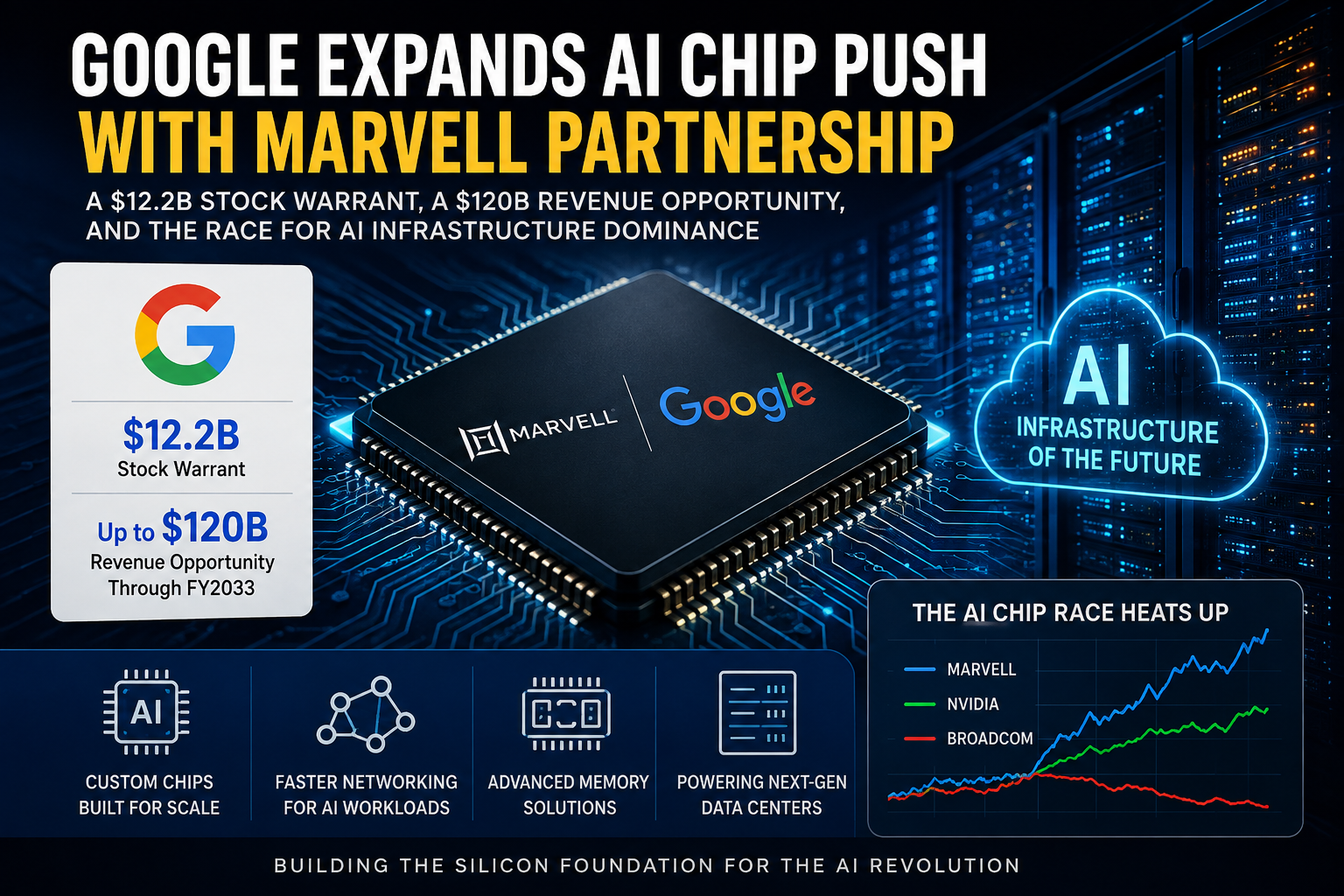
The agreement could become extremely valuable for Marvell. Reuters reports that the arrangement could generate as much as $120 billion in revenue for Marvell through fiscal 2033 if Google meets specified performance targets.
Google Could Become a Major Marvell Shareholder
One of the most interesting elements of the agreement is a stock warrant provided to Google.
Google has received the right to purchase approximately 58.97 million Marvell shares at $206.58 per share. If fully exercised, the warrant would represent roughly $12.2 billion worth of Marvell shares and could potentially make Google one of the semiconductor company’s largest investors.
The financial markets quickly reacted to the announcement. Marvell shares climbed following the news, while Broadcom shares declined as investors considered how Google’s expanding relationship with Marvell could affect the competitive landscape for custom AI silicon.
Why Big Tech Wants Custom AI Chips
Modern AI systems require enormous amounts of computing power. Training advanced models and serving AI features to millions of users can require huge fleets of specialized processors.
Nvidia remains a dominant supplier of AI accelerators, but companies such as Google, Amazon and Microsoft have increasingly invested in their own chips.
There are several potential advantages to custom silicon.
Companies can optimize processors for their own workloads, potentially improve performance per watt, reduce infrastructure costs and diversify their dependence on external chip suppliers.
Google’s TPU ecosystem is particularly important because the company operates AI products across Search, Gemini, Workspace, Cloud and numerous other services.
As AI usage increases, controlling more of the underlying computing infrastructure could become an increasingly important competitive advantage.
The AI Competition Is Moving Into Hardware
For the past several years, much of the public AI competition has focused on models and applications.
But underneath those products is another enormous race involving processors, networking systems, memory, data centers and electricity.
Google’s expanded relationship with Marvell demonstrates how important this infrastructure layer has become.
Rather than depending entirely on general-purpose AI GPUs, technology companies are building specialized processors optimized around their own platforms and workloads.
This could eventually create a more diverse AI chip market where Nvidia remains highly influential but competes with increasingly powerful custom-silicon ecosystems.
What It Could Mean for Nvidia and Broadcom
Google’s partnership with Marvell does not necessarily mean the company is abandoning other chip suppliers.
Reuters reported that analysts largely see the move as an effort by Google to diversify its AI supply chain rather than completely replace existing partners.
However, the scale of the agreement shows that competition in custom AI silicon is intensifying.
Broadcom has historically played an important role in Google’s TPU ecosystem, while Nvidia remains central to the broader AI infrastructure industry. Adding another major semiconductor partner gives Google additional flexibility as its computing requirements expand.
AI Infrastructure Is Becoming the Next Big Tech Battleground
The development also reflects a broader technology trend.
Building better AI models is only one part of the challenge. Companies must also secure enough processors, memory, networking equipment, data-center capacity and power to operate them at massive scale.
That means the companies capable of controlling both AI software and the infrastructure underneath it could gain a major advantage.
Google’s growing investment in custom silicon suggests that future AI competition may increasingly be determined not just by which company has the best chatbot or AI model, but by which company can build the most efficient computing ecosystem behind it.
Conclusion
Google’s expanded partnership with Marvell is another indication that the global AI race is entering a new phase.
AI models remain important, but chips and infrastructure are becoming equally strategic.
With an agreement potentially generating up to $120 billion for Marvell through fiscal 2033 and a warrant allowing Google to acquire up to approximately $12.2 billion in Marvell shares, this is far more than a routine supplier relationship.
As Google, Microsoft, Amazon and other technology giants continue investing in custom processors, the next major battle in artificial intelligence may happen inside the data center — at the chip level.
