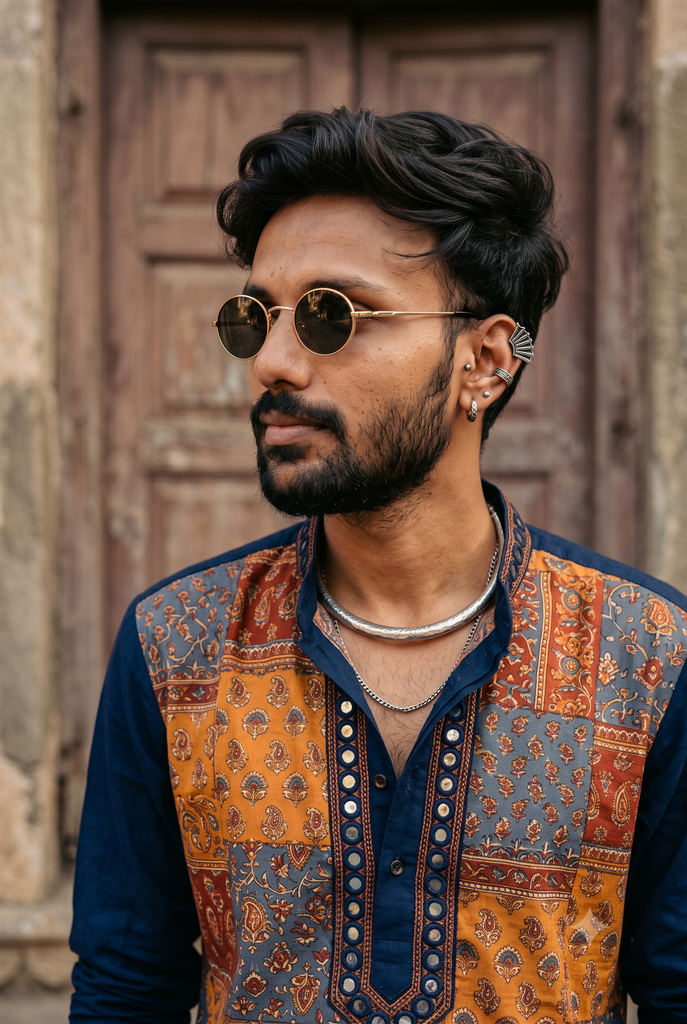
Rich navy fabric, intricate mirror work and silver jewellery bring a distinctive charm to this Indian ethnic portrait. Framed against a weathered wooden doorway, the look blends traditional craftsmanship with modern confidence through round sunglasses, swept-back hair and a composed sideways gaze. Soft daylight and subtle retouching give the face a fresh, healthy glow while preserving natural skin texture, skin tone and recognizable features. This guide explores how to recreate that editorial aesthetic with a detailed AI portrait prompt.
1.Prompts
Create a photorealistic Indian ethnic fashion portrait in a vertical 2:3 aspect ratio, closely recreating the supplied reference image’s camera angle, pose, framing, outfit, accessories and heritage setting. Use my uploaded personal photograph as the strict facial identity reference. Preserve my recognizable facial structure, nose, lips, jawline, skin tone and natural proportions. Maintain my identity while applying the reference styling.
Capture a tight upper-body portrait, cropped from above the hair to the middle of the chest. Position the subject slightly right of centre, leaving a small amount of open space toward screen left, in the direction he is facing. Keep the entire hairstyle within the frame. His torso is subtly angled toward screen left, and his head turns farther toward screen left into a clear three-quarter view. The ear on screen right remains fully visible. Keep his chin slightly elevated, neck elongated naturally, shoulders relaxed and lips gently closed. His expression is calm, confident and composed, with his gaze directed off-camera toward screen left. Both hands remain completely outside the frame.
Place the camera approximately at face height, slightly below the eye line, creating a subtle upward impression without exaggerated perspective. Use the visual feel of an 85mm portrait lens at approximately f/2.8. Maintain sharp detail across the face, sunglasses, visible ear jewellery and collar, while softly blurring the wooden doorway behind him. Keep the framing intimate, with the face and upper torso dominating the photograph.
Style the hair in thick, dark, voluminous layers, swept upward and backward with a loose side part. Create a broad lifted wave above the forehead, textured strands across the crown and slightly longer layered hair extending behind the visible ear toward the nape. Keep the hair naturally groomed with a soft sheen and a few loose strands. Preserve natural facial-hair characteristics from my identity photograph, with realistic individual hairs and skin texture.
Add small, round sunglasses with thin gold-toned metal rims, a delicate curved bridge and slender temples. The lenses are dark charcoal with subtle reflections of trees and the surrounding outdoor courtyard. Position them naturally across the upper nose, below the eyebrows, allowing the brow shape to remain visible. Match their modest circular proportions rather than using oversized glasses.
Decorate the visible ear on screen right with an ornate oxidized-silver upper-ear cuff. The cuff has a small fan-shaped, layered filigree design with tiny bead-like details. Add a small silver hoop at the earlobe and a tiny nearby stud. Around the base of the neck, place a thick, smooth, slightly irregular silver torque necklace with a softly hammered handmade finish. Include a second fine silver chain descending into the open neckline, with its lower portion partly hidden by the garment.
Dress the subject in a deep navy-blue traditional kurta with a colourful patterned front. Keep the sleeves and outer shoulder areas predominantly solid navy. The front fabric combines irregular patchwork-style blocks and strips of mustard orange, rust red, muted slate blue and navy, filled with intricate paisley motifs, tiny floral patterns, ornamental medallions and fine geometric details. Preserve the densely printed textile appearance without turning every motif into raised embroidery.
Give the kurta a short upright collar and a partially open front neckline. Edge the collar and front opening with textured dark navy-black embroidered trim containing evenly spaced circular mirror-work discs. Continue a matching mirror-work strip vertically along the outer edge of the patterned chest panel near the shoulder on screen right. The mirrors should show varied silver-white and muted green reflections, with realistic stitching around each disc. Keep the neckline open enough to reveal the silver torque and a small portion of the upper chest. Render natural cotton texture, subtle seams and believable fabric folds.
Place the subject directly in front of a weathered heritage wooden double door set into an aged brown stone doorway. Use tall rectangular wooden panels with faded honey-brown tones, darkened edges, visible grain, scratches and worn surface variations. Include a broad stone jamb along the left side and a narrower portion of the doorway on the right. Keep the architecture softly out of focus but recognizable, with mostly straight vertical lines and no modern objects.
Use soft natural daylight from the front-left, gently illuminating the forehead, nose, cheek and lips. Maintain delicate shadows beneath the jaw, along the neck and behind the visible ear. Give the face a fresh, healthy appearance through balanced exposure and subtle luminous highlights while preserving the original skin tone, pores and facial structure. Avoid dull grey skin, excessive smoothing or artificial skin whitening. Let the sunglasses rims, silver jewellery and mirror-work catch small controlled highlights.
Apply restrained cinematic colour grading with warm brown architectural tones, rich navy fabric, vivid but believable orange-red textile accents and natural skin colour. The final image should resemble a polished editorial photograph taken in an old Indian heritage courtyard: realistic, detailed and naturally stylish. No direct eye contact, no broad smile, no front-facing pose, no hands in frame, no oversized sunglasses, no altered facial proportions, no plastic skin, no illustration, no text, logos or watermark. face thoda glow up karna
Output
2.Prompts
Create a photorealistic Indian festive menswear portrait in a vertical 9:16 aspect ratio, closely recreating the supplied reference photograph’s pose, camera angle, outfit, framing and lighting. Use my uploaded personal photograph as the strict facial identity reference. Preserve my recognizable facial structure, eyes, nose, lips, skin tone and natural proportions. Use the festive reference for styling and composition without copying its model’s identity.
Frame the subject from slightly above his hair to just below his knees, with the lower legs and footwear outside the frame. Position him centrally, allowing his body and scarf to fill most of the image. Keep a small amount of headroom and show the complete hanging ends of the scarf. Photograph from approximately upper-chest height with a level camera and natural perspective, using the visual feel of an 85mm portrait lens at approximately f/2. Keep the subject sharply detailed against a strongly blurred festive background.
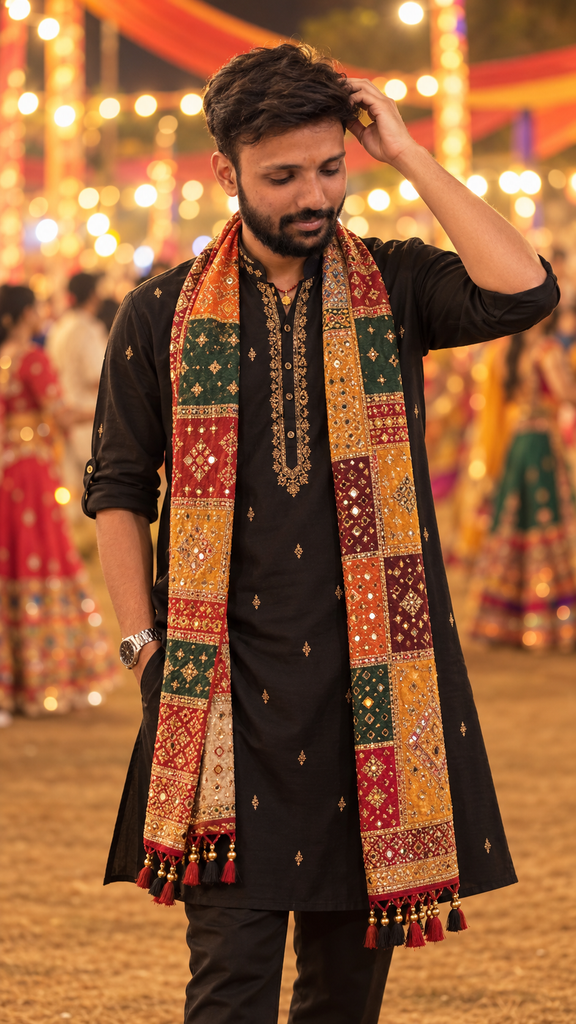
Recreate the pose precisely: his torso faces almost directly toward the camera, with relaxed shoulders and a subtle shift of weight onto one leg. His head is bowed and turned toward screen right, his own left, with his chin lowered and his gaze directed toward the ground. Show a partial three-quarter view of his face beneath the falling hair. His expression is quiet and thoughtful, with closed lips and relaxed eyebrows.
Raise his left arm on screen right, bending the elbow outward at roughly shoulder-to-chest level. The forearm rises diagonally toward the top-right side of his head. Place his left hand naturally within his hair near the crown and left temple, with the fingers gently spread and curved as though he is brushing his hair back. Preserve realistic finger placement and wrist alignment. His right arm on screen left hangs downward with a slight elbow bend, and his right hand rests inside the kurta’s side pocket near his hip. Keep the pocket opening and fabric tension believable. Add a silver metal-link wristwatch with a round dark dial to the visible right wrist on screen left.
Style the hair in thick, dark, naturally voluminous waves, swept loosely back at the crown with several curved strands falling across the forehead. Let the raised hand slightly lift and separate the hair. Preserve the facial identity and natural grooming of my personal reference.
Dress him in a matte black, knee-length traditional kurta with a short stand collar and a narrow front placket extending to the middle of the chest. Outline the placket with delicate gold-beige embroidery, small repeating floral details and tiny decorative buttons. Scatter small, widely spaced gold embroidered motifs across the front of the kurta, maintaining generous areas of plain black fabric. Keep the fit comfortable and slightly tailored, with natural folds around the waist, pocket and lower torso. Roll or fold both sleeves to just below the elbows, exposing the forearms, and include a small sleeve tab with a subtle button on screen left. Pair the kurta with black trousers partially visible at the bottom.
Drape a richly decorated multicoloured scarf around the back of his neck, with two long panels hanging down the front to approximately knee level. Keep the scarf open at the centre so that the kurta’s embroidered placket remains visible. Its surface features a patchwork arrangement of rectangular and square sections in crimson red, burnt orange, mustard, deep emerald green, cream and dark maroon. Fill the panels with intricate gold-toned geometric embroidery, diamond patterns, tiny floral motifs, dotted embellishments and small reflective mirror-like accents. Preserve the slightly textured woven fabric and soft, substantial folds.
On screen left, let the scarf travel from the shoulder down beside the pocket, then flare outward slightly near the lower edge. On screen right, let it hang in a broader, straighter panel across the front of the torso. Finish both ends with decorative knotted fringe, small red and black tassels and dangling golden beads. Keep the fringe clearly visible, irregular and physically natural.
Set the scene at an outdoor Indian Navratri or Garba celebration at night. Include softly blurred festival guests in colourful traditional clothing, warm illuminated poles, hanging decorations and broad red-orange fabric swags stretching diagonally across the upper background. Add scattered warm white and golden bulbs at different heights, rendered as large circular bokeh highlights. Show a softly lit, earthy brown ground behind the lower body. Keep the background atmospheric and indistinct.
Illuminate the subject with soft, warm light from the front and slightly from screen right, revealing the face, raised forearm, scarf embroidery and folds of the black fabric. Add gentle golden highlights around the hair and shoulders from the surrounding festival lights. Retain detail in the black kurta without lifting it to grey. Use rich amber-brown background tones, warm natural skin colour and controlled highlights, with cinematic contrast and realistic shadow depth beneath the lowered face.
Maintain realistic skin texture, anatomically correct hands, detailed embroidery, natural hair strands, believable fabric weight and shallow optical depth of field. The final image should feel like a professional candid festive fashion photograph. No smiling at the camera, no direct eye contact, no altered pose, no extra hands or fingers, no distorted wrist, no plastic skin, no cartoon styling, no text, logos or watermark.
Output
3.Prompts
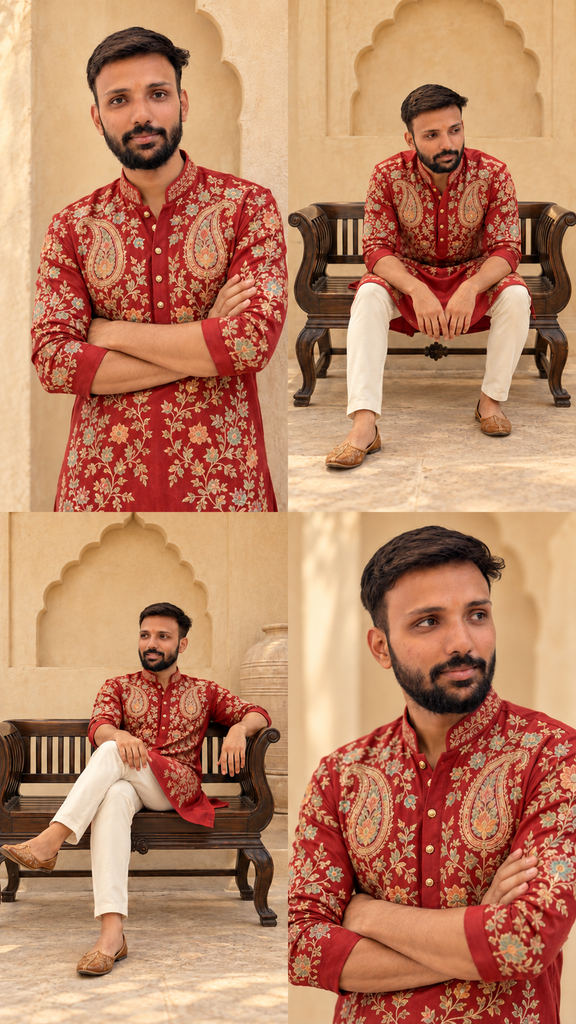
Create a photorealistic Indian festive menswear editorial collage in a vertical 9:16 aspect ratio, arranged as a precise 2×2 grid of four photographs. Use my uploaded personal photograph as the strict facial identity reference in every panel. Preserve my recognizable facial structure, eyes, nose, lips, skin tone and natural proportions consistently across all four images. Use the supplied collage as the reference for layout, poses, clothing, setting and colour treatment.
Divide the canvas into four equal rectangular panels with clean, edge-to-edge joins and no thick borders or spacing. Keep the same person, outfit, hairstyle, grooming, location and lighting throughout. The overall aesthetic is warm, understated and elegant, resembling a coordinated festive menswear campaign photographed inside a sandstone heritage courtyard.
Dress the subject in a rich crimson-red kurta with a short stand collar, a partially open neckline and a narrow red button placket with small gold-toned buttons. Cover the fabric with elaborate floral and paisley ornamentation in antique gold, muted sage green, pale turquoise, peach, ivory and soft pink. Include large curved paisley motifs across the chest, flowering vines across the shoulders and sleeves, and delicate decorative detailing throughout. Render the ornamentation with fine thread-like texture and restrained metallic highlights. Keep the exact design, colours and motif placement consistent between panels.
The kurta should fit comfortably through the shoulders and torso, extending toward the knees in the seated images. Push the sleeves up to just below the elbows, exposing the forearms and creating believable fabric bunching. Pair it with plain ivory straight-cut trousers and tan-brown leather slip-on jutti-style shoes with gently tapered toes and subtle stitched detailing. Avoid adding jewellery, scarves, sunglasses or other accessories.
Use the same warm beige-ochre plaster wall throughout, featuring shallow decorative niches with scalloped Mughal-style arch outlines. Preserve subtle surface texture, soft colour variations and an earthy heritage character. The floor is warm sandy beige. For the seated panels, include a dark polished wooden bench with a low seat, curved slatted armrests at both ends, sweeping curved legs and a horizontal front support with a small dark ornamental detail.
TOP-LEFT PANEL:
Create a tightly cropped standing portrait from just above the hair to the waist. Position the subject toward the right side of this panel, allowing his left shoulder and part of his left side to meet the central vertical grid boundary. His torso faces mostly forward with a slight angle, and his head tilts gently toward screen right. He looks directly into the camera with a restrained, friendly closed-mouth smile.
Fold both arms naturally across the lower chest. His left hand rests on his right upper arm, while the opposite hand is mostly tucked beneath the other arm. Show realistic overlapping forearms and relaxed fingers. Emphasize the embroidered collar, chest motifs and rolled sleeves. Use a close portrait perspective with softly blurred plaster and a partial arch outline behind him.
TOP-RIGHT PANEL:
Show a full seated portrait on the wooden bench, including both shoes and the bench’s curved legs. Place the subject in the lower-middle of the panel, leaving substantial wall space above his head. He sits with his knees apart and his feet planted forward, his right foot extending farther toward screen left.
Lean his torso forward from the hips. Rest his forearms on his thighs near the knees, with both hands hanging loosely between his legs, close together but not tightly clasped. Lower his head and turn it slightly toward screen left, looking down with a relaxed, thoughtful expression. Let the red kurta gather naturally across his lap, with ivory trousers forming soft folds at the knees. Keep the bench and footwear fully readable.
BOTTOM-LEFT PANEL:
Create a wider environmental seated portrait, with the subject and bench occupying the lower half of the panel and generous empty wall space above. He sits comfortably back on the same bench, angled slightly toward screen left. Cross his right leg over his left at the knee, with the raised tan shoe extending toward screen left. His left leg descends toward the floor, with its shoe visible near the lower-left foreground.
Rest his left forearm along the curved armrest on screen right, with the hand relaxed near the seat edge. Let his other hand rest naturally around the crossed knee or lap. Turn his head toward screen left, looking off-camera with a small, easy smile. Include a large pale earthenware vessel on the floor behind the bench at screen right, with a rounded body, narrow mouth and subtle horizontal bands. Show the full bench and its curved supports.
At the top of this bottom-left panel, place the exact text “Festive look for men” in an elegant white serif font. Keep it on one line, horizontally centred within this panel, with modest spacing below the horizontal grid boundary. Use a clean editorial style without a text box, outline or shadow.
BOTTOM-RIGHT PANEL:
Create a close portrait cropped from the top of the hair to the lower crossed forearms. Let the subject fill almost the entire panel, with minimal headroom and portions of the outer arms cropped at the edges. His torso faces mostly toward the camera, while his head turns toward screen right. He looks off-camera with a subtle, confident smile.
Fold both arms across the chest, keeping the overlapping forearms visible at the bottom. Show one hand resting naturally against the opposite upper arm near the right edge. Preserve detailed embroidery across the chest and shoulders, the stand collar, open placket and visible sleeve folds. Keep the ochre wall softly out of focus.
Maintain the same neatly styled dark hair throughout, with natural volume at the front and a softly swept texture. Preserve facial hair and defining features from my identity photograph. Apply subtle editorial retouching to create a fresh, healthy glow while retaining realistic pores, natural skin colour and recognizable facial proportions.
Use soft, warm daylight from the front-left, creating gentle facial modelling and delicate shadows beneath the chin, arms and bench. Keep the lighting consistent across the collage. Preserve rich red fabric, creamy ivory trousers, warm brown wood and muted gold embroidery without excessive saturation. Avoid harsh flash, deep orange skin tones or overly glossy fabric.
Use the visual feel of a 70–85mm portrait lens for the close panels and approximately 50mm for the seated panels. Keep natural perspective, sharp facial detail and realistic depth of field. In the wider photographs, retain enough focus to show the bench, clothing and wall niches clearly.
The finished collage should look like four coordinated photographs from one professional fashion shoot. Maintain exact facial and outfit consistency, believable seated anatomy, correct hand placement and natural fabric folds. No repeated identical poses, mismatched faces, extra fingers, warped furniture, distorted shoes, heavy beauty filters, cartoon rendering, additional text, logos or watermark.
Output
4.Prompts
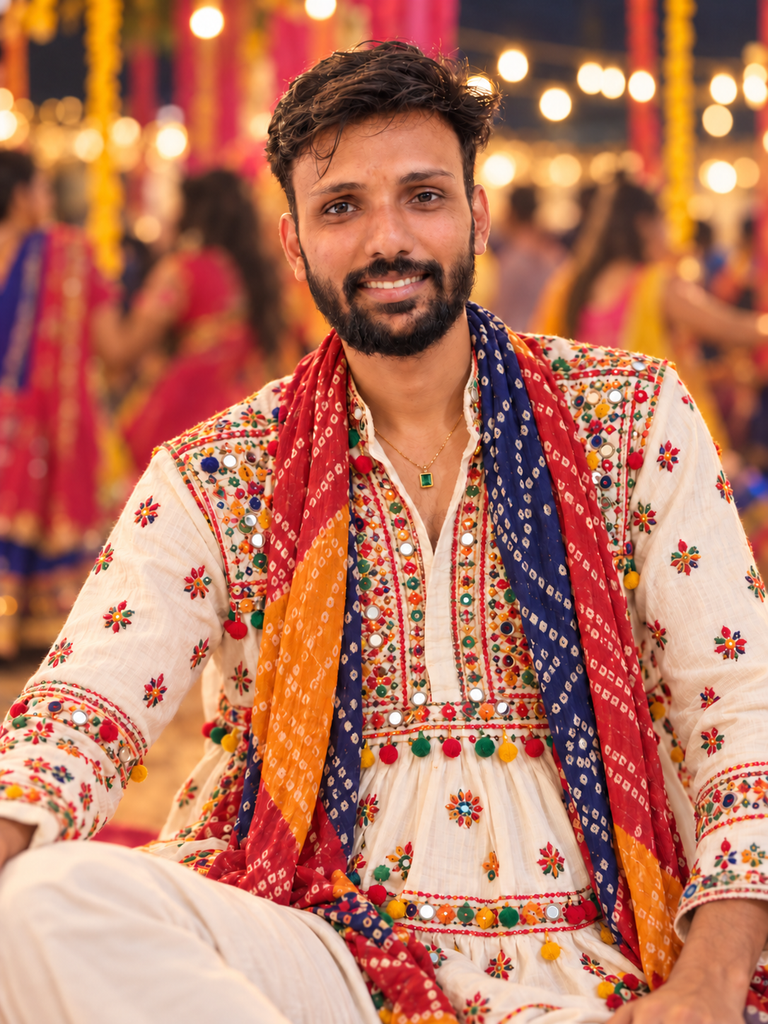
Create a photorealistic Indian festive portrait in a vertical 3:4 aspect ratio, closely matching the supplied reference image’s pose, framing, clothing, lighting and atmosphere. Use my uploaded personal photograph as the facial identity reference, preserving my recognizable facial structure, eyes, nose, lips and skin tone.
CAMERA AND COMPOSITION:
Capture a tightly framed seated portrait, from slightly above the hair down to the lap. Position the camera approximately at the subject’s eye level, with a natural portrait perspective and the visual feel of an 85mm lens at f/1.8. Place the head slightly right of centre, keeping the entire hairstyle visible with a small amount of headroom. Let the shoulders and torso fill most of the frame. Include a softly blurred, cream-clothed bent knee entering the bottom-left foreground. Keep the eyes and face sharply focused, with the festive crowd and decorations strongly blurred behind him.
POSE AND EXPRESSION:
The subject sits casually, leaning his upper body toward screen right. His shoulder on screen left sits higher, creating a gently sloping diagonal across the frame. Tilt his head slightly toward screen right, following the relaxed lean of his body. Keep his face directed toward the camera with direct eye contact and a warm, natural, teeth-showing smile. His expression should feel candid, friendly and joyful, with softly lifted cheeks and relaxed eyebrows. His left forearm extends toward the lower-right edge, resting naturally near his lap, with the hand largely outside the frame. His other arm remains partly cropped on screen left. Preserve believable seated anatomy without inventing extra visible hands.
HAIR AND GROOMING:
Give him thick, dark, tousled, wavy hair with loosely defined curls and individual strands falling across the forehead. The hair should appear slightly damp and naturally voluminous, with warm highlights along the outer strands. Include a neatly maintained short beard and moustache, with realistic facial-hair texture.
OUTFIT AND ACCESSORIES:
Dress him in an ivory-white traditional Gujarati kediyu-style festive garment made from softly textured cotton. The garment has a short stand collar, an open V-shaped neckline, long sleeves and a gathered, flared section below the chest. Decorate it with intricate multicoloured embroidery in red, orange, green, yellow and royal blue. Include tiny floral motifs across the sleeves and body, densely embroidered vertical panels beside the neckline, decorative shoulder panels, horizontal embroidered borders and small circular mirror-work elements that catch the warm light. Add colourful miniature tassels and pom-poms in red, green and yellow around the embroidered seams and gathered sections.
Drape a long multicoloured bandhani-style scarf loosely around the back of his neck, with both ends falling down the front. The scarf combines deep navy blue, crimson red, orange and yellow sections, covered in tiny white dotted patterns and diagonal decorative bands. Keep the drape uneven and natural, with soft folds overlapping the embroidered garment. Pair the outfit with cream trousers visible on the raised knee. Add a delicate gold chain with a small rectangular green gemstone pendant resting near the open neckline.
BACKGROUND:
Set the portrait at a lively outdoor Navratri Garba celebration at night. Behind the subject, show a softly blurred crowd wearing colourful traditional Indian clothing. Include indistinct women in vibrant red, blue, yellow and pink festive outfits, along with other guests. Decorate the venue with vertical yellow marigold garlands, red and pink fabric accents, and multiple strings of warm glowing bulbs suspended overhead. Turn the distant bulbs into large, soft golden bokeh circles. Keep the background lively but visually subordinate to the face.
LIGHTING AND COLOUR:
Use soft, warm golden illumination coming from the front-left of the camera, flattering the face and revealing natural skin texture. Add subtle amber edge lighting to the hair and shoulders from surrounding festival lights. Maintain gentle shadows beneath the chin and around the neckline. Preserve rich reds, deep blues, vibrant embroidery and creamy whites under the warm light. Apply cinematic amber colour grading without making the skin excessively orange. Mirror-work details should reflect small, realistic points of light.
FINISH:
Professional festive portrait photography, realistic pores, fine facial hair, detailed embroidery, visible cotton texture, natural fabric folds, realistic optical depth of field and an intimate candid atmosphere. No plastic skin, excessive retouching, illustration, artificial HDR, distorted anatomy, extra fingers, text, logos or watermarks.
Output
5.Prompts
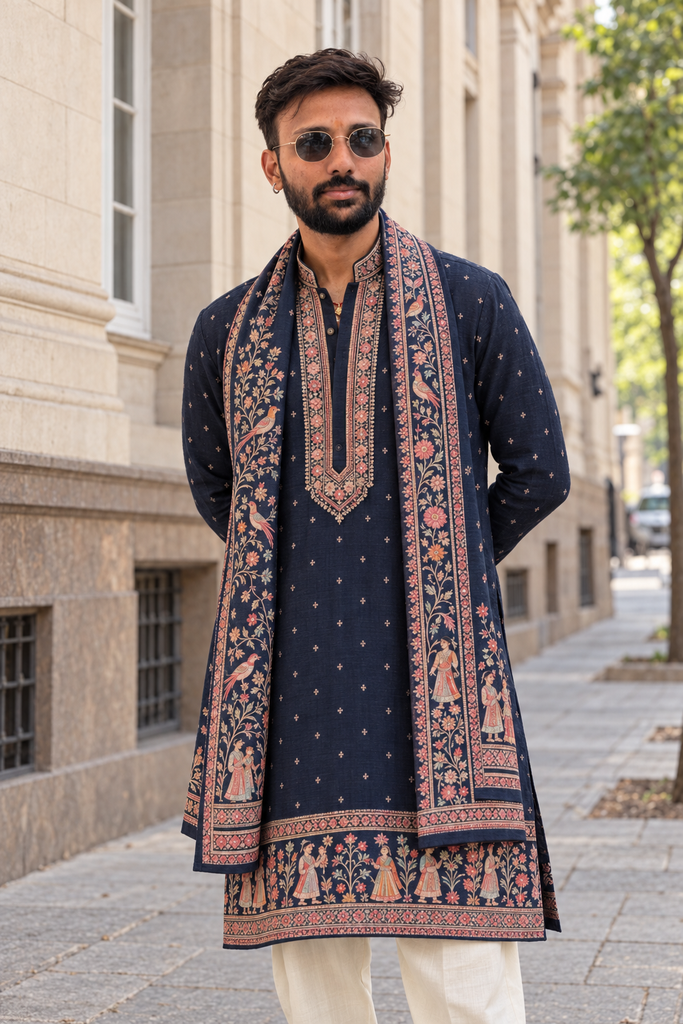
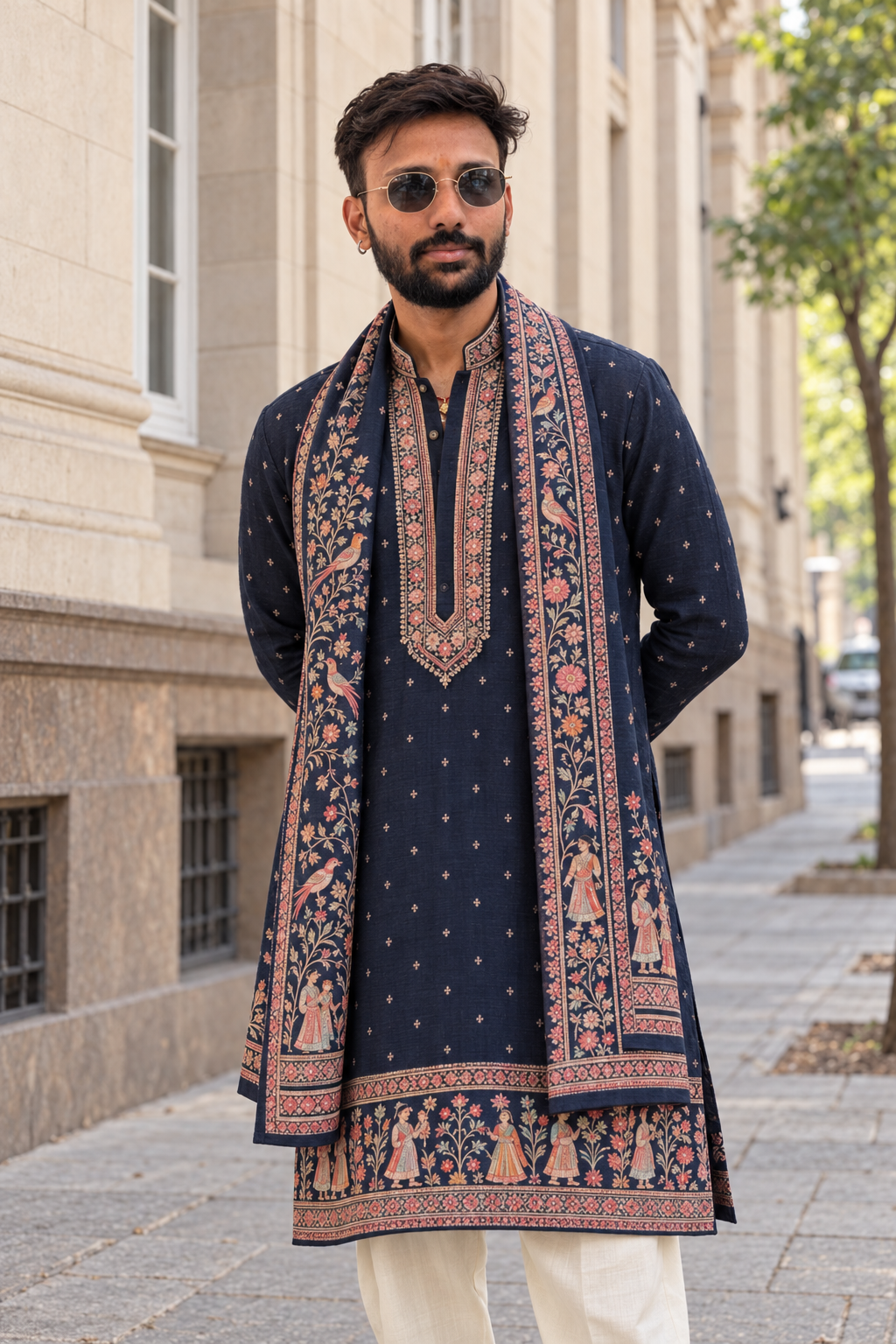
Create a photorealistic Indian ethnic menswear street portrait in a vertical 2:3 aspect ratio, closely recreating the supplied reference photograph’s standing pose, camera angle, outfit, framing and architectural setting. Use my uploaded personal photograph as the strict facial identity reference. Preserve my recognizable facial structure, eyes, nose, lips, skin tone and natural proportions.
Frame the subject from above the hair to approximately the middle of the shins, with the footwear outside the frame. Position him near the centre, slightly toward screen right, leaving generous architectural space above his head. His body faces almost directly toward the camera, with a slight turn toward screen left. Keep his posture upright and relaxed, shoulders gently drawn back, and both hands held behind his lower back. The elbows angle subtly outward, particularly on screen right. No hands should be visible in front of the body.
Keep his head nearly level, with the chin subtly raised and the face turned slightly toward screen left. His gaze points ahead and just left of the camera behind dark sunglasses. Give him a calm, confident expression with relaxed, closed lips. Preserve the still, composed standing pose without introducing a walking step or crossed arms.
Position the camera approximately at the subject’s upper-abdomen to chest height, with a nearly level view and natural body proportions. Use the visual feel of an 85mm portrait lens at approximately f/2.8 to f/4. Keep the subject sharply focused while allowing the building and pavement to soften progressively into the distance. Use the receding wall and sidewalk as diagonal leading lines toward the upper-right background.
Dress him in a deep midnight-navy, knee-length kurta with a relaxed straight silhouette and long sleeves. Cover the navy fabric with tiny, evenly scattered pale dots or miniature stitched motifs. Give the neckline a short stand collar and an elongated open slit, with a dark inner placket and a small button visible near the top.
Surround the neckline with a wide, intricate ornamental panel in dusty rose, coral, muted peach, ivory and pale gold. The decoration runs vertically down both sides of the opening and ends in a pointed, layered geometric shape around the middle of the chest. Include fine floral borders, miniature repeating patterns and delicate stitched detailing. Preserve the navy centre opening and realistic folds along the chest.
Decorate the kurta’s lower hem with a broad narrative-style textile border containing small traditional human figures, floral elements and ornamental bands in pink, coral, orange, pale blue and cream. Keep the decoration concentrated around the lower edge while most of the kurta body remains navy with tiny scattered motifs.
Drape a long, broad navy stole around the back of his neck, with two substantial panels hanging straight down the front almost to the kurta hem. Keep the stole open at the centre so the embellished neckline remains clearly visible. Both panels feature elaborate folk-art-style imagery: flowering vines, leafy branches, stylized birds, miniature traditionally dressed figures and decorative scenes in dusty pink, peach, coral, ivory and muted orange.
Edge each stole panel with multiple narrow patterned borders, including pink geometric bands and fine cream detailing. The panel on screen right hangs slightly straighter, while the panel on screen left has a few softer folds near the shoulder and lower section. Render the stole as a richly patterned woven or finely embroidered textile with realistic weight, subtle texture and matte colour. Avoid glittery sequins or oversized mirror-work.
Pair the kurta with loose ivory-white trousers, visible beneath the hem at the bottom of the frame. Keep their fabric plain and softly folded. Do not add a jacket, waistcoat or belt.
Add small rounded sunglasses with thin gold-toned metal rims, a delicate bridge and dark charcoal-blue lenses. Keep their shape slightly oval rather than perfectly circular, with subtle reflections of the surrounding street and building. Include small silver hoop earrings, with a slightly layered hoop arrangement on the more visible ear at screen right.
Style the hair in thick, dark, naturally voluminous waves, swept loosely upward and back with a few soft strands near the forehead. Let the sides remain gently textured and slightly longer around the ears and nape. Preserve the facial-hair characteristics and defining features of my uploaded identity photograph.
Set the scene on a quiet paved sidewalk beside a tall pale-beige stone building. The building fills the left side and most of the background, with large rectangular masonry blocks, projecting vertical stone sections, recessed tall windows with white frames and a darker sandy-brown horizontal band across the lower façade. Include small basement windows with pale metal bars near pavement level.
Let the building and sidewalk recede diagonally toward screen right. Use rectangular grey paving slabs with visible joints, subtle weathering and occasional small patches of greenery between edges. Along the far-right side, include narrow soil patches or tree pits beside the walkway. Show soft green foliage in the upper-right distance and a small, heavily blurred portion of a parked grey vehicle near the far-right background. Keep the street understated and free of distracting crowds.
Use soft, diffused daylight with gentle illumination from the front-left. Maintain even facial exposure, subtle shadows beneath the chin and natural depth in the navy fabric. Keep the colour palette slightly cool and restrained: pale beige stone, charcoal-grey pavement, rich midnight navy, dusty pink textile patterns and clean ivory trousers.
Apply subtle professional retouching to give the face a fresh, healthy glow while preserving original skin tone, realistic pores and facial structure. Keep the image crisp and natural, with detailed fabric patterns, individual hair strands and believable optical depth of field.
The final image should resemble an elegant outdoor ethnic-fashion editorial. Preserve the hands-behind-back stance, dark sunglasses, straight hanging stole and architectural perspective. No exaggerated smile, no visible hands in front, no altered facial identity, no distorted anatomy, no artificial skin smoothing, no excessive saturation, no cartoon rendering, no text, logos or watermark.
Output